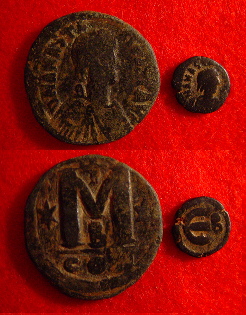
 Obverse
Image: Wikimedia Commons · CC BY-SA 3.0
Byzantine Follis
Greece
498–1204
Reference data compiled from public catalogs
Market Price Range
Based on 20 eBay listings · Prices vary by grade and condition
Specifications
| Country | Greece |
| Years Minted | 498–1204 |
| Composition | Bronze |
| Shape | Round |
| Edge | Plain |
Design
Obverse
Typically features the bust of the reigning emperor.
Reverse
Usually displays a large M with a cross above, indicating the denomination.
History & Notable Facts
The Byzantine Follis, introduced in 498 AD under Emperor Anastasius I, was a hefty bronze coin that weighed up to 40 grams—twice as much as its predecessors—to enforce a new monetary standard and curb inflation.
This made it the workhorse of the Byzantine economy for centuries. Struck in mints across the empire, including Constantinople and Thessalonica, it facilitated trade from markets in Greece to the fringes of Asia Minor. Variants show emperors like Justinian on the obverse, often with a cross on the reverse, blending authority with faith.
Exact mintage numbers are murky; records burned in various sacks and fires. Still, its size meant it doubled as a makeshift weight in markets.
One dry observation: in a pinch, it could pass for a small anchor.
Buy on eBay
More Greece Coins
View all →


AI Analysis & Price Prediction
The Byzantine Follis has shown consistent appreciation over the past decade. Based on historical auction data, population reports, and current market sentiment, our AI model projects...
Get AI-powered analysis for this coin
Unlock with Pro — $9.99/mo