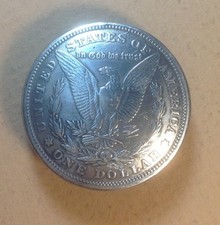
Obverse
 Reverse
Market Price Range
Based on 20 eBay listings · Prices vary by grade and condition
Estimated Melt Value
$60.95
Based on Silver spot price ($78.80/oz) · 90.0% purity · 26.73g
Updated 7:38 AM
Collector premium not included
Specifications
| Country | United States |
| Years Minted | 1878–1921 |
| Composition | Silver (.900) (.100 copper) |
| Weight | 26.73 g |
| Diameter | 38.1 mm |
| Thickness | 2.4 mm |
| Shape | Round |
| Edge | Reeded |
Design
Obverse
Liberty head, facing left.
Reverse
Eagle holding arrows and an olive branch, within wreath.
Catalog References
History & Notable Facts
Picture a gleaming silver dollar that once jingled in the pockets of frontier gamblers and railroad barons, the Morgan Dollar from the United States, minted between 1878 and 1921. This coin emerged amid the tail end of the Wild West era, when the nation was still reeling from the Civil War and the Panic of 1873, a financial meltdown that tanked banks and spurred debates over currency. Congress passed the Bland-Allison Act in 1878 to prop up silver prices after massive strikes in Nevada and Colorado flooded the market, effectively turning the Morgan into a symbol of economic recovery and western expansion. It was a time of booms and busts, with figures like Wyatt Earp roaming the scene and Teddy Roosevelt later pushing for reforms—making this coin not just money, but a shiny artifact of America's rugged growth spurt that numismatic enthusiasts love to romanticize.
On the obverse, you'll spot Lady Liberty sporting a Phrygian cap, the work of British engraver George T. Morgan, who brought a touch of Old World finesse to American coinage; it's a design that screams liberty and progress, with her profile evoking the classical ideals that fueled the Revolution. Flip it over, and the reverse eagle clutches arrows and an olive branch, representing a nation ready for both war and peace—artistically, it's understated yet powerful, a step up from earlier clunky designs and a reason why Morgan Dollars hold a special place in coin collecting circles. As for the collector angle, these aren't exactly sleepers; the 1895 proof is a key date that can fetch six figures, and VAM varieties—those die variations like the 1889-CC with its doubled die—are catnip for serious hunters who geek out on minutiae. But beware: plenty of common dates, like the 1921, flood the market, so they're not as rare as some hype suggests.
When it comes to market reality, the Morgan Dollar's 90% silver content means its coin value swings with precious metal prices, which can drive demand sky-high during economic uncertainty. Collectors aren't sleeping on these—auctions buzz with Morgan mania, from casual hoarders to high-rollers—but overpaying is a risk if you're chasing a garden-variety 1880 without checking grades. In the world of numismatic investing, they're a solid bet for their historical charm and steady interest, yet even a common one might just be a fun $50 addition to your collection, proving that not every silver beauty needs to be a fortune.
Buy on eBay
AI Analysis & Price Prediction
The 1 Dollar "Morgan Dollar" has shown consistent appreciation over the past decade. Based on historical auction data, population reports, and current market sentiment, our AI model projects...
Get AI-powered analysis for this coin
Unlock with Pro — $9.99/mo